Crisp jalebi depends on several steps working together. The batter must flow in a controlled stream, the spirals need an even thickness, the oil must be ready without overheating, and the fried jalebi should meet the syrup briefly rather than sit in it.
Quick summary

- Use batter that forms a steady stream, not a runny puddle or broken ribbon.
- Test the oil with a small amount of batter and adjust the heat according to how quickly it colours and sets.
- Pipe compact, consistent spirals and avoid overcrowding the pan.
- Prepare the sugar syrup before frying so the jalebi can be dipped while both components are ready.
- Soak briefly, drain well, and judge the finish by crispness, colour, and syrup balance.
What makes jalebi crispy?
Crisp jalebi has a defined outer shell, an evenly cooked spiral, and enough structure to hold syrup without becoming limp immediately. Batter that is too loose can spread and absorb more oil, while thick or unevenly piped batter may brown outside before the centre cooks properly.
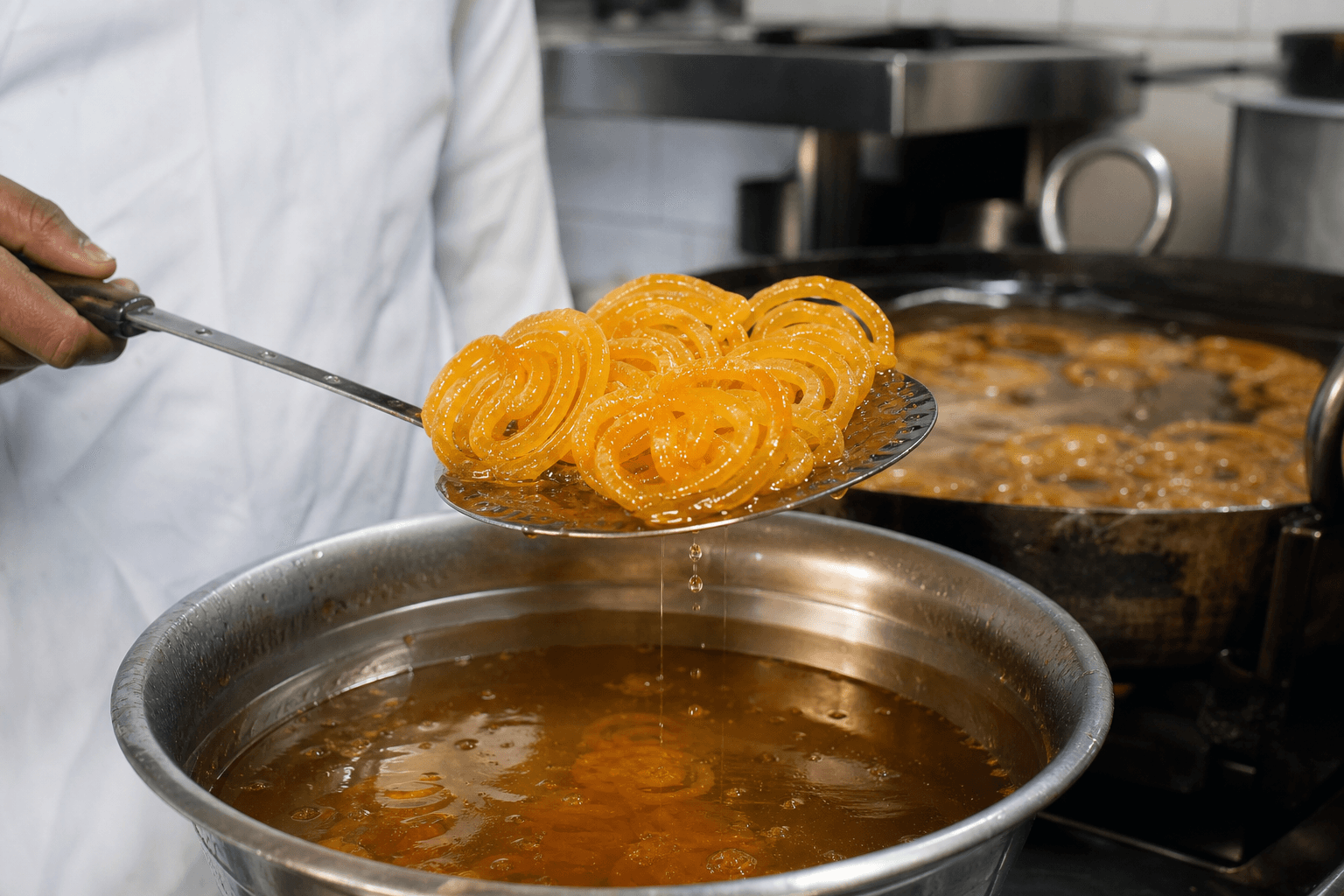
Frying creates the shell, but syrup determines the final balance. Too little exposure leaves the jalebi poorly coated. Too much allows syrup to penetrate heavily and soften the surface. An official Indian food document describes the basic sequence as piping batter into hot oil until golden and crispy, followed by a brief dip in sugar syrup. This fry-then-syrup sequence is the foundation for the adjustments below.
Ingredient choices also affect how batter behaves. For broader context on how ingredients influence Indian sweets, see Indian sweet ingredients, particularly when comparing substitutions or trying to understand why a mixture flows differently between batches.
Prepare the batter and syrup for even frying

Before heating the oil, check whether the batter can be dispensed in a continuous, controlled stream. It should hold a line briefly as it lands, but it should not be so stiff that the piping motion breaks the spiral. If it spreads immediately, the loops can merge. If it comes out in lumps or fragments, the spirals may break apart.
Use a clean, controlled piping bag, squeeze bottle, or jalebi maker. The opening should remain consistent because a changing stream produces thin sections that burn beside thicker sections that remain undercooked. Keep the tool close enough to control the shape, while taking care to avoid splashing.
Prepare the syrup before frying. It should be ready to receive the jalebi, not waiting while the first pieces cool. The syrup should coat the fried spirals smoothly without making the finish heavy. These jalebi syrup finishing tips offer related guidance on coordinating the coating stage.
Control the spiral shape and oil readiness
Even spirals are easier to fry than large, irregular shapes. Start from the centre and guide the stream in compact circles, leaving enough space for the batter to expand without merging. Aim for consistent line thickness rather than speed.
Judge oil readiness through observable batter behaviour rather than an arbitrary temperature number. A small test piece should begin to set and rise without immediately turning dark. If it spreads widely, the oil may not be ready or the batter may be too loose. If it colours almost at once while remaining soft, the oil is likely too hot.
Adjust the heat gradually. Oil temperature can drop when too much batter enters the pan, then rise again when the pan is less crowded. Watch the colour and firmness of each batch, not only the burner setting.
Fry jalebi step by step
- Test a small piece. Observe whether it holds its shape, sets, and colours at a manageable pace.
- Pipe controlled spirals. Work with a small number of pieces so the oil has room to circulate.
- Keep the thickness consistent. Thick overlaps take longer to cook, while thin tails can darken quickly.
- Move or turn the pieces as needed. Use a suitable utensil to expose both sides when the shape or pan requires it.
- Remove them when structured and appropriately coloured. They should look set and crisp, not pale and limp, but should not darken before the interior develops.
- Drain briefly, then transfer to syrup. Do not carry excess oil into the syrup or leave the jalebi waiting for a long period.
Batch size matters because a crowded pan makes it harder to maintain even heat and shape. A smaller, observable batch gives you a better chance to correct the next one.
Coordinate frying with warm syrup soaking
Jalebi and syrup should be ready at roughly the same stage. If the syrup becomes cool or thick, it may not coat smoothly. If the fried jalebi waits too long, it may lose the texture created in the pan.
Dip each piece briefly and turn it as needed so the syrup reaches the surface evenly. Then lift it out and allow excess syrup to drain. The goal is a balanced coating that adds sweetness and shine while leaving the spiral's structure noticeable.
When jalebi becomes soft quickly, the cause may not be syrup alone. Uneven frying, excess batter moisture, oil that was not ready, or a long soak can all contribute. Change one factor at a time so you can identify the most likely correction.
Jalebi frying problems and practical corrections
| Symptom | Likely causes | Practical correction |
|---|---|---|
| Soggy jalebi | Under-frying, excess batter moisture, prolonged soaking, or heavy coating | Check that the spiral sets fully, shorten the syrup exposure, and drain well. |
| Greasy jalebi | Oil not ready, overcrowding, or batter absorbing too much oil | Test the oil again, fry fewer pieces, and check whether the batter is spreading. |
| Pale and soft jalebi | Oil too cool, spirals too thick, or early removal | Allow the oil to recover and use a more consistent stream. |
| Dark outside but soft inside | Oil too hot, thick overlaps, or uneven piping | Reduce the heat, make thinner lines, and avoid repeated overlaps. |
| Uneven or broken spirals | Inconsistent batter flow, an unstable tool, or changing pressure | Keep the tool steady and practise a continuous circular motion. |
| Too syrupy | Long soaking, heavy syrup, or insufficient draining | Use a brief coating stage and lift the jalebi promptly. |
These symptoms can overlap. Pale jalebi, for example, may reflect cool oil, thick spirals, or both. Make a small test batch before changing the entire pan.
Jalebi quality and safety checklist
- Use dry, clean utensils and keep the work area organised.
- Position the pan securely and keep hands, handles, and loose clothing away from splashes.
- Have the piping tool and syrup ready before starting.
- Test the oil with a small amount of batter.
- Keep the batch size manageable.
- Look for consistent structure and colour, not simply fast browning.
- Coat briefly and drain excess syrup.
- Correct a greasy, dark, pale, or soft first batch before making more.
How this connects with fresh jalebi in Abbotsford
Jalebi frying techniques are general cooking guidance, not a description of Super Punjab Sweet House's private recipe, equipment, oil, batter, or syrup process. Super Punjab Sweet House is an Abbotsford sweet shop offering 100% vegetarian Punjabi sweets, samosas, and chaat. Its official website describes fresh daily preparation and notes that jalebi may still be warm later in the afternoon.
That context helps local readers distinguish between learning the technique at home and choosing freshly prepared jalebi from a Punjabi sweet shop. Confirm current options directly before planning a larger order.
Frequently asked questions
Why does jalebi turn soggy after frying?
Jalebi can become soggy when it is under-fried, exposed to syrup too long, or made with a batter carrying excess moisture. Check a test piece before coating the whole batch, then shorten soaking and drain more thoroughly if needed.
Should jalebi be dipped into warm or hot syrup?
The syrup should be ready and warm enough to coat the fried jalebi smoothly. Excessive heat or prolonged contact can create a heavy, soft finish, so use a brief dip.
How can I stop jalebi from becoming greasy?
Check whether the oil allows the batter to set rather than spread. Overcrowding can lower the heat and increase absorption. Fry fewer pieces and drain them before they enter the syrup.
Why does jalebi turn dark before it becomes crisp?
The oil may be too hot, or the spiral may be too thick in places. Lower the heat gradually and pipe a more even line.
How do I make jalebi spirals more even?
Use a tool with a consistent opening and maintain steady pressure. Start at the centre, move in compact circles, and avoid repeatedly crossing the same line.
Build crispness through control
The most reliable way to improve jalebi is to treat frying as a coordinated sequence. Begin with predictable batter flow, confirm the oil's behaviour with a small test, form even spirals, manage the batch size, and coat the finished pieces briefly in prepared syrup.
If you are in Abbotsford and want to explore fresh Punjabi sweets locally, Super Punjab Sweet House offers 100% vegetarian mithai and savory snacks at 31940 South Fraser Way, including fresh jalebi described on its website.